
Nine Modules, One Record.
Every module writes to the same concept-level record. That is why the app can tell you what to do next instead of only what you scored — and why a parent, a teacher and a student never end up describing the same week three different ways.
Each section ends with one thing that module does not do. Those lines are there on purpose.
Open the app and it already knows where you stopped.
There is not a single navigation tile on the Home screen. Every card is live data that deep-links into the exact place you left off.
- Continue, not "browse" Each card points at the block, phase or paper you were actually in.
- Focus areas Your weakest concepts, named, each one tap from the material that fixes it. Not "you are weak in Genetics" — which idea inside it.
- The countdown and the streak Days to NEET, and a streak that breaks only if you do.
- Progress to Doctor Measured on what you completed. A high-water mark — it never goes down.
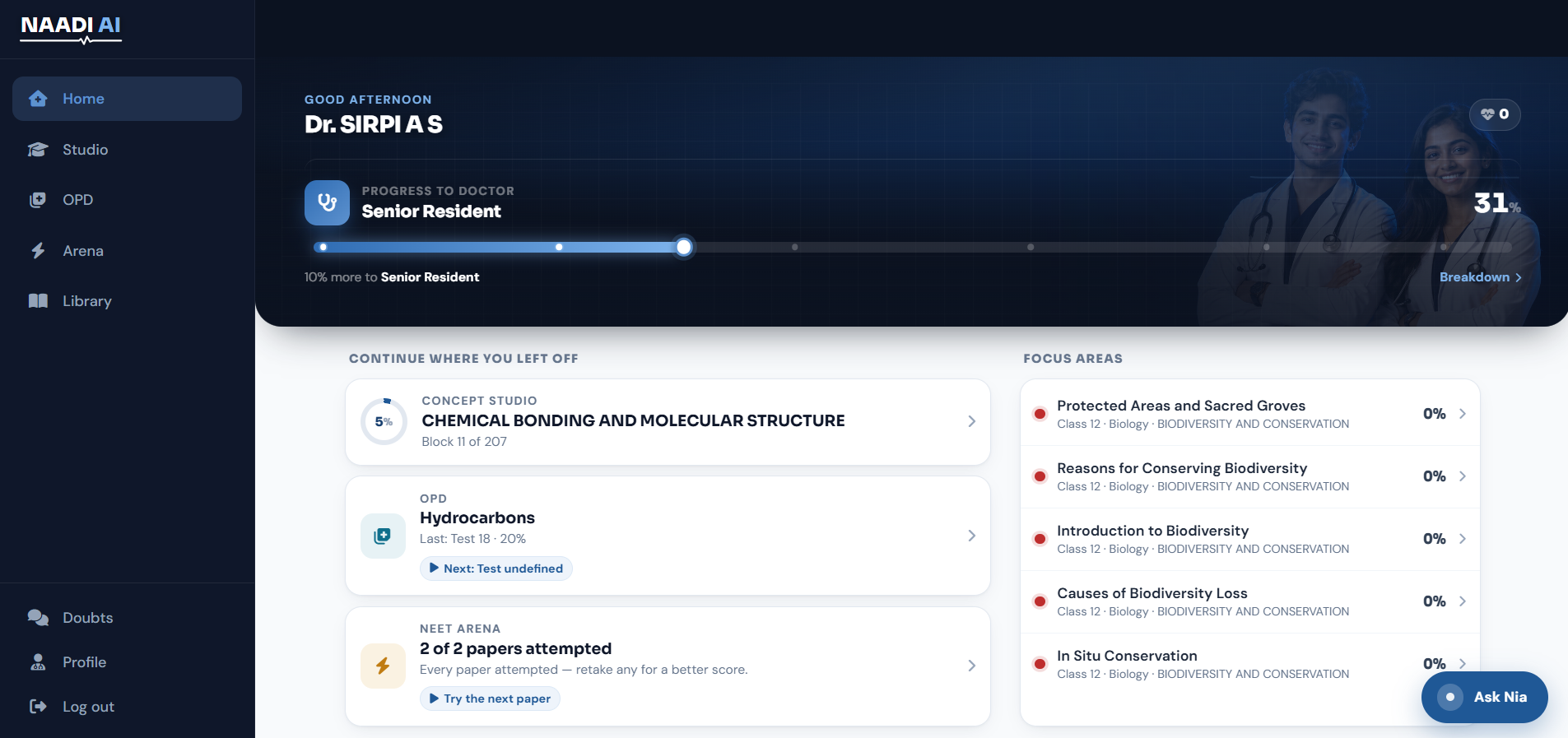
Doesn't do: show you a rank prediction, or any number that can drop on a bad day. Nothing on Home is allowed to go down — a figure that falls when you are already struggling is the figure that closes the app.
Every concept, opened seven ways.
A chapter is a list of concepts, and each one arrives with the same seven layers in the same order. This is a real one — click through it.
Understand
Definition, values, the exam tipDefinition
Atoms combine either by transfer of valence electrons from one atom to another, or by sharing of valence electrons, in order to have an octet in their valence shells.
Watch out for
- Applies only to second and third period elements seeking noble-gas configurations.
- Hydrogen and helium are exceptions — hydrogen is stable at a duplet, not an octet.
Checkpoint · say it back
Who formulated the octet rule, and in which year? Under what condition does hydrogen stand outside it?
Visual map
Where this sits · the processKey relationships
Octet Ruleexplains mechanism ofChemical Bond Formation
Octet Ruleachieved throughElectron Transfer or Sharing
Octet Ruleproposed byKössel and Lewis (1916)
Apply it
Spot it, then solve itWorked scenario
Nitrogen (Z = 7) and three hydrogen atoms form ammonia. Is the octet satisfied for nitrogen — and by transfer or by sharing?
Nitrogen is 1s² 2s² 2p³ — five valence electrons in the second shell.
In NH₃ it forms three covalent bonds, sharing one pair with each hydrogen: 5 + 3 = 8.
Sharing, not transfer — hydrogen cannot accept three electrons, and nitrogen cannot lose five and stay stable.
NEET traps
The mistake + an A–R drillThe trap
Assertion–Reason · NEET favourite
AIn ammonia, nitrogen achieves the octet through electron transfer from hydrogen.
RNitrogen has 5 valence electrons and needs 3 more, which hydrogen can provide.
D. Nitrogen shares — it does not receive transferred electrons — so A is false. R states the electron count correctly, so R is true.
Flashcards
Card 3 of 8 · hardest firstClick the card to flip it
Past questions
1 real · 1 practiceNEET · previous year
Which of the following does not obey the octet rule in its stable compound?
C. Boron completes only six electrons in BF₃ — an incomplete octet, and the electron-deficient exception NEET returns to most often.
NAADI's recap
Before you go · 4 things NEET tests hereAssembled from the six layers above · NCERT pages 3–4
Doesn't do: replace NCERT. Every concept links back to the source page it came from, and the app tells you to check anything that matters against it.
Learn by being tested, like a real ward round.
You see cases, not chapters. Your mistakes decide what comes next, so the chapter reorganises itself around you as you go.
- Your path is yours alone Two students who open the same chapter get different journeys through it.
- Tracking at concept level Not "72% in Genetics" — which idea inside it broke, and where.
- AI that names the mistake Miss the same idea twice and the test stops. A tutor names the misconception and hands you a differently-trapped version before you continue.
- Analysis after every case Concept by concept, question by question, with the time you spent on each.

Doesn't do: let you skip ahead. A phase closes when its content is spent, not when a test counter hits a number — so nobody finishes a chapter having never been asked about a third of it.
Sit the real paper, before the real day.
Full-length papers on a real OMR sheet, against a real clock.
- Full NEET papers The whole paper, the whole duration, the same OMR bubbles you will fill in the hall.
- Results worth reading Score ring, subject accuracy, per-question timing, and the traps you fell for. Skipped and wrong are counted separately, because under negative marking they are opposite problems.
- All India Rank Where you stand against every NAADI student who sat the same paper — category-aware, so the number means what you think it means.
- College prediction What this score would have opened, based on the paper you just sat.
Doesn't do: predict your actual NEET rank. It tells you what this score would have opened on a past paper. A rank estimate built from a handful of attempts is unstable enough to be misleading, so we don't publish one.
Build the exact test you need today.
Every past-year question, sorted and cross-matched. You choose the shape of the paper — class, subject, chapter, concept, count and difficulty.
- Any combination Class × subject × chapter. One chapter or twelve — the test is assembled for you, and the match count updates as you narrow it.
- Cross-matched across years The same concept, asked five different ways across five different papers.
- Same engine, same analysis A custom test is graded exactly like an Arena paper. Nothing here is a lesser test.
- Or just browse the papers The full papers are in there too, year by year, if you would rather sit one whole.
Doesn't do: generate questions. Every question here was on a real paper — that is the entire point.
Your material and your notes, in one place.
Everything you read and everything you wrote, together — because that is how revision actually happens.
- Highlight as you read Mark what matters. It stays marked when you come back at 1 a.m. in March — and it survives zooming, because a highlight is stored against the page, not against a pixel.
- Notes you actually find again Notebooks per subject and chapter, saved the moment you write them. A note taken inside the reader remembers the chapter and page it came from.
- Take it offline Download study material and read it without a signal. Export a whole notebook as a PDF when you want it on paper.
- Read it how you like Light, sepia and dark reading modes, remembered between sessions.
Doesn't do: cover every subject with PDFs yet. Biology's study material is complete; Physics and Chemistry are still being built. We would rather you read that here than find it out on your first evening.
Point at anything. Ask about it.
Nia is attached to the page you are on — the concept, the chapter, the question you just got wrong and the option you picked. You never have to explain the context before you can ask.
- Highlight a line, get it explained Select any sentence — in a concept, a PDF, an explanation — and ask for it in plainer words, or as something you can actually remember.
- "Why is my answer wrong?" On any reviewed question that is already a complete question. She can see what was asked, which option you chose, which was right, and what the trap in yours was.
- Walk a numerical, step by step Ask for the next step rather than the answer and she hands you one line at a time, so you finish it yourself.
- She keeps the thread Follow up with "why?" or "another example" without repeating yourself. Every conversation is saved and reopenable — and she tells you when a fresh chat would give a sharper answer.

Doesn't do: stay open during a live test. The launcher disappears and the server refuses independently — ask her anything the moment you submit.
A thread, not a ticket.
One continuous conversation that stays open. Nothing gets closed on you because a queue needed clearing.
- The NAADI team, always reachable One thread, from your first day to your last. Scroll back through everything you have ever asked.
- Your own teachers When your school or coaching centre is on NAADI, your class teacher and subject teachers appear here too — class teacher first, because that is who you look for.
- Replies find you A badge shows up wherever you are in the app — you do not have to remember to go back and check.
Doesn't do: promise an instant answer. It is a conversation with people, and we would rather not fake a response time we cannot hold.
Two more front doors.
Separate logins, separate screens, the same underlying record — so a parent and a class teacher are never told two different stories about the same student.
For parents
- Home Is this going all right this week?
- Learning Where are they in the syllabus?
- Tests How did the tests go — and what did they get wrong?
- Insights What is happening inside the chapters being tested?
No phase jargon, no predicted rank, no other child's name. Chapter tests and full papers are never averaged.
The parent portalFor teachers
- Home Who needs me today?
- Class Where is the syllabus, and how is the group doing?
- Students The full roster, in the same words.
- Concepts Where is the class weak, and what do I say in the lesson?
Coverage and mastery are never blended. A concept below the sample floor gets a dash and the reason, never 0%.
The teacher portalDoesn't do: let a parent or a teacher change anything. Nothing in either portal alters a student's tests, answers or progress.
Three roles, one record.
Each role gets a screen built for its own question — not a trimmed copy of somebody else's.
| Learning | Student | Parent | Teacher |
|---|---|---|---|
| Concept Studio | Full | — | Read-only progress |
| Library & notes | Full | — | — |
| Syllabus position | Yes | Yes | Per class and subject |
| Must-know concepts left | Yes | Yes | Per student |
| Testing | Student | Parent | Teacher |
|---|---|---|---|
| Adaptive Practice (OPD™) | Sits it | Sees the outcome | Sees the outcome |
| NEET Arena full papers | Sits it | Marks and trend | Class distribution |
| Custom Tests | Builds and sits | Sees the outcome | Sees the outcome |
| The actual wrong questions | Yes | Yes | Yes |
| Analysis | Student | Parent | Teacher |
|---|---|---|---|
| Concept-level weakness | Own | Own child | Own class |
| Retention check outcome | Yes | Yes | Yes |
| Teaching brief per concept | — | — | Yes |
| When the studying happens | — | Yes | — |
| Class rank / percentile | — | Off by default | Yes |
| Predicted NEET rank | Never | Never | Never |
| Communication | Student | Parent | Teacher |
|---|---|---|---|
| Nia | Yes | — | Teaching-scoped |
| Doubts threads | Yes | — | Yes |
| Guardian contact details | — | — | Revealed on request, logged |
| Can change anything | Never | Never | Never |
A student subscription includes the parent portal at no extra cost. The teacher portal is provisioned with your school or coaching centre.
Now the part that explains itself.
Every decision above has a reason behind it — including the ones where we took a feature out. The Protocol page is those reasons, with the numbers.