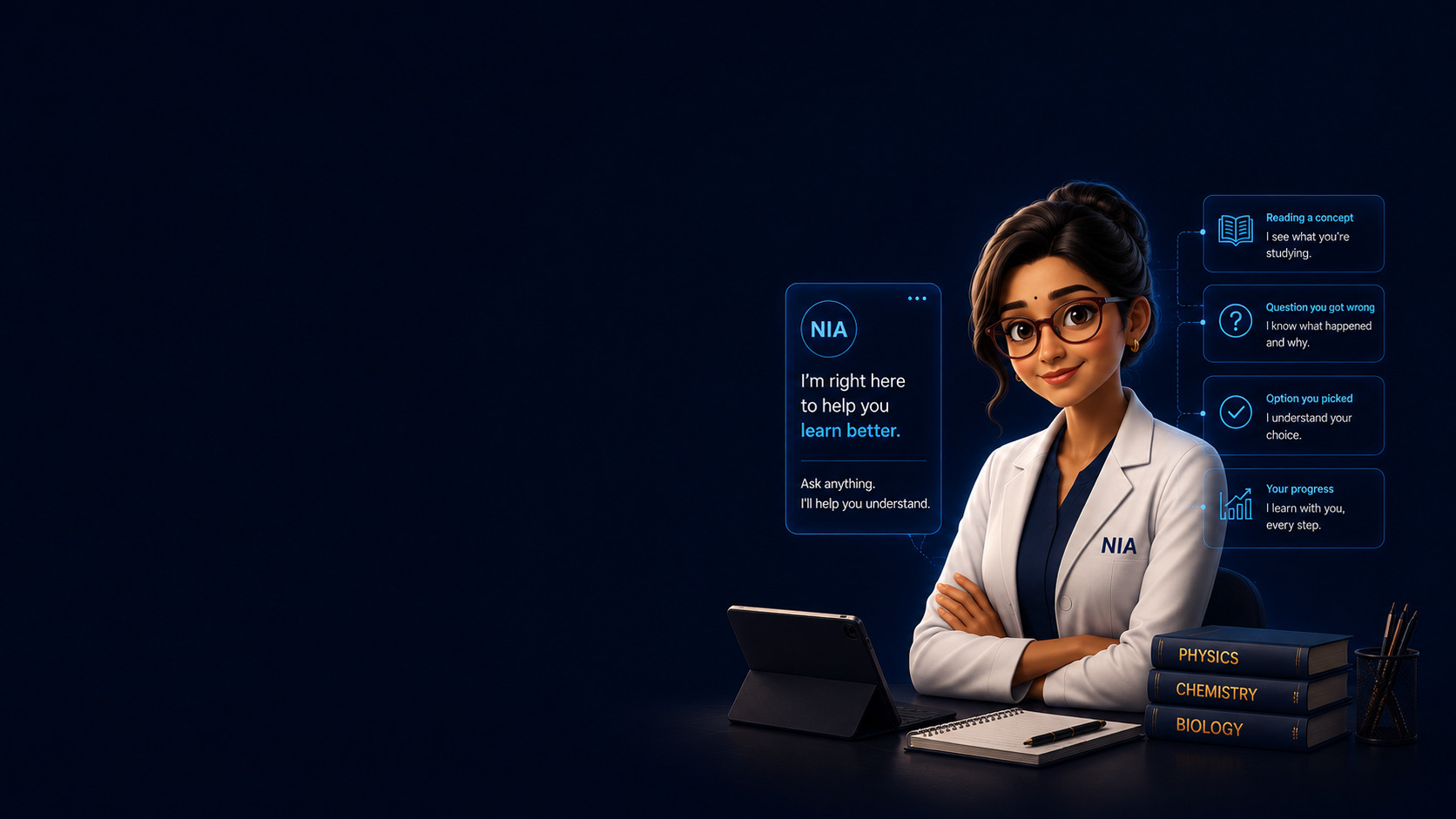
She Already Knows What You're Looking At.
Nia is attached to the page you are on — the concept you are reading, the question you just got wrong, the option you picked. No screenshots. No pasting. No explaining yourself before you can ask.
Subjects only · Closed during a live test · Never handed your contact details · Every conversation saved to your account
Four screens. Four different Nias.
Start with what she is holding. The assistant never changes — what she has been handed does, screen by screen, and on one screen she is not there at all.
Nia can be wrong. Check anything that matters against NCERT or ask your teacher.
She is handed the actual text of the concept block you have open — looked up on the server from its ID, never scraped off your screen. Move to a different section and what she is holding moves with you.
Nia can be wrong. Check anything that matters against NCERT or ask your teacher.
On a results page she is given the question, every option, which one you chose and which was right. With several questions open she works from the last one you expanded — the one actually on your screen — rather than guessing between them.
Nia can be wrong. Check anything that matters against NCERT or ask your teacher.
Away from a concept or a review she is an ordinary tutor for Physics, Chemistry and Biology — still carrying your record, still saving everything, just without a page to point at.
The launcher disappears the instant a paper starts, and the server refuses the request on its own account. Two independent locks, because hiding a button is a courtesy, not enforcement.
Highlight a line. That is the whole interface.
If she already has the page, asking about it should not need a sentence. The line you did not understand is right there — selecting it is faster than describing it, and it cannot be described wrong.
- Select it and ask Any sentence, anywhere — a concept, a PDF, an explanation. The button appears where you selected, and the line goes across with your question.
- Or press the button on the card Every reviewed question in Adaptive Practice, NEET Arena and the PYQ Vault carries Ask Nia about this question. One tap, nothing typed.
- She lets go when you move Walk from a concept to a test review and the conversation starts fresh, rather than answering about the page you left an hour ago. The old one is still in your history.
Doesn't do: read your whole screen. A selection has to be a real fragment — roughly a clause up to a long paragraph. A stray word gets nothing, and neither does highlighting an entire page.
The part a general chatbot structurally cannot have.
The page and the gesture are the easy part. The third thing she is handed is a short summary of how you have actually been doing — from the same record your teachers and parents see. Not a transcript. A summary, capped, used for one purpose.
What she is given
The concepts you have struggled with recently, by their real names — Ostwald's dilution law, not a chapter code — and your current level on the ladder. That is the whole of it. Not your marks, not your history, not a list of everything you have ever got wrong.
What she does with it
Pitches the answer at you, and nothing else. She will not open with your weak spots, will not recite your accuracy back at you, and will not turn an explanation you asked for into a progress report you didn't.
And if you ask her directly? She tells you — plainly, briefly, then offers to work on the weakest part. Deflecting a student's question about their own results reads as a lecture, so she does not. If there is no data yet she says exactly that and points you at Progress, rather than guessing at a number.
You already have an AI. It just doesn't know you.
The screen, the gesture, the record — a general chatbot has none of the three. The gap was never intelligence; the models are broadly the same. It is context, and every general chatbot bills you for it in your own study time.
Everywhere else
Screenshot the question. Retype the four options because the crop cut one off. Say which one you chose. Explain what you already tried, and what your teacher said last week. Get an answer pitched at nobody in particular — and start again from zero tomorrow.
Inside NAADI AI
Press the button on the card you are already reading. She has the question, every option, the one you picked, the one that was right, the chapter it came from, and how you have done on that concept before. You type four words: why is this wrong?
The limit: Nia is a tutor, not an oracle. Every answer carries the same footer inside the app that it carries here — she can be wrong, and anything that matters should be checked against NCERT or taken to your teacher.
An answer that ends in a dead end is a dead end.
So she answers well. Most AI features stop there. Under every reply here are two buttons, and neither is a thumbs-up.
- Save it to a notebook File the answer into any of your notebooks, sitting next to your own notes on the same chapter — not in a separate AI history nobody revisits.
- Still stuck? Hand it to a human Opens a real thread with a teacher from your own class — your subject teacher for that chapter offered first — with your question and Nia's answer already attached, so they can see what you tried. An ordinary Doubts thread, with Doubts' supervision.
- Follow up without repeating yourself She reads the last six messages, so "why?" and "another example" both work. Change topic and she says a fresh chat would be sharper — a conversation that wanders gets vaguer, and she tells you rather than pretending otherwise.
- And a human is watching that thread The class teacher can read every doubt thread in their own class — read-only, on a route with no write sibling, leaving no trace in the conversation. A question handed over by an AI does not get a private back-channel around your school.
No counters, no meters. Every conversation is saved, titled and tagged with the concept it was about. There is a fair daily limit on starting a new topic — follow-ups inside one are always free, so an explanation is never cut off half way — and no visible tally, which would only make students ration their questions.
What she refuses — and won't apologise for.
That is everything she does. The next three sections are what she does not — and they were settled before the first line of the assistant was written.
- Physics, Chemistry, Biology. Nothing else. Politics, relationships, entertainment, general chat — one warm line saying she only handles your subjects, then a question about what you are working on. No lecture, no paragraph about why she can't.
- Nothing at all during a live test The launcher is hidden and the request is refused on the server. Two independent locks — the one you can see is only a courtesy.
- Never a question you haven't submitted If it looks like you are asking her to sit your paper for you, she declines and offers the underlying concept instead.
- Only what your plan has unlocked Ask about a chapter you do not have and she says so. She will not read you a chapter through a side door.
And under every single answer, unchanged since day one: Nia can be wrong. Check anything that matters against NCERT or ask your teacher. Note what is not fenced: Adaptive Practice's own v3 tutor does not run through any of this, because core teaching must never be rate-limited, plan-gated, or switched off by a toggle.
Proportionate first. Escalated when it must be.
A fence says where the edge is. This is what happens when someone walks into it — and one crude word is not a safeguarding incident.
Every message is checked before it reaches a model at all. Nothing is sent, nothing is billed, and the refusal is instant.
Mild language gets a warm one-line redirect and a private counter. No report is written and nobody is told.
Anything severe — or a third flag — writes a real report, message attached, into the Safety screen your administrators already watch.
She does not refuse and move on. She says plainly that a teacher, a parent or a counsellor is the next step — and never discusses methods of self-harm.
And it can be switched off. Administrators disable Nia, cap her, or gate her by plan from their own console.
Most of the risk in an AI feature is what it is allowed to read.
Which leaves the last question, and the shortest answer here: four things Nia is never handed, each a decision rather than a promise.
- Never the page itself Your device sends an identifier, never the text on your screen. The server looks the content up and re-checks that you are entitled to it — because a client that can name its own content can name anybody's.
- Never anyone's contact details Guardian name, phone and email, student email and phone, photos and linked parent accounts are stripped before a prompt is assembled. Guardian contact sits behind its own route with its own access log — a prompt would walk straight round that.
- Never someone else's record Scope is read from the stored record, never from the request that asked for it. A teacher reaching for a student outside their own approved class gets nothing back, and the attempt is written to the log.
- Never anything unfiltered on the way back The reply is escaped and cut down to a short whitelist of formatting tags on the server, then checked again in the browser. Two passes, because a client that trusts a server string absolutely is one bug away from a bad day.
What staff can see, honestly: administrators see what Nia costs per student and what the conversations were titled — a school running the feature has to see what it spends — but not the bodies. Supervision applies to doubt threads, and only within one class: the class teacher of 11-B sees nothing in 12-A.
Same pulse. Different brain.
Everything above is the student's Nia. A teacher gets different instructions, a different budget and a different job — not explaining the subject, but how to teach it.
- On the home screen — about the names already on it The students flagged as needing attention today are on the teacher's screen by name, so she can answer about them. "What is happening with Ezhili?" gets an answer, not a shrug.
- On a class — what they are collectively stuck on The concepts the most students are weak on, counted across the roster, with how many each. Then the part that matters: how to teach it tomorrow.
- On one student — including the ones who only look fine Accuracy, retention, weakest and strongest concepts — and the questions they recovered on at v2 but failed at the v3 audit. Memorised the example, not the rule. That is the sentence most worth having.
- Lesson plans, analogies, misconceptions "Why do they keep getting this wrong" gets the misconception named, not the mistake. And because an analogy that is subtly wrong is worse than none, she tells you where each one breaks down.
Hard lines: their own approved roster only, never guardian contact, never a draft message to a parent, never a disciplinary suggestion, and never speculation about a student's home life — a wellbeing concern belongs with the class teacher or the school's own process. Teachers get no daily cap.
The fastest way to judge her is to ask her something.
Open a concept, get a question wrong on purpose, and press the button. She will already know what you are looking at.
No predicted ranks. No guaranteed scores. And no counter telling you how many questions you have left.